How to Sight in a Scope - Step by Step Guide
Article Posted: July 16, 2012
 The following is a step by step guide on how to sight in a scope, also known as zeroing in. Even if you've sighted one in before this post could be used as a refresher.
The article details Dominant Eye Issues, Breathing Techniques, Picking a Scope, Necessary Equipment, Target, Rifle Position, and Shot Group.
Hope this is of some use to you, if it is be sure to Share, Like, Tweet, and Email this article to your friends.
Dominant Eye
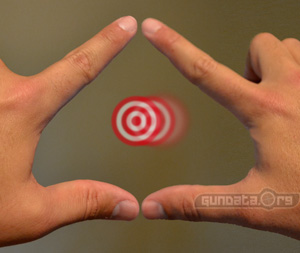 For first time shooters finding your dominant eye is important. Some people are under the impression that using your dominant arm is required for shooting a weapon, but it doesn't really matter which arm you use to shoot with as long as you use your dominant eye.
- Make a triangle with your hands facing flat as if you were going to do a diamond push-up.
- Pick an object in the distance such as a picture on a wall or a fire alarm on the ceiling.
- Keeping your arms at a 90 degree angle; look through the triangle you made with your hands and slowly extend your arms outward while staying focused on the object.
- Once your arms are fully extended close each eye one at a time to see which is centered on the object-that will be your dominant eye and the side of your body that you place the butt of your rifle on when shooting.
Breathing Technique
Breathing is an important part of shooting to make sure each shot is well-placed. Practicing breathing before going to the range can help cut down on the time it takes to zero in a rifle. Shot groups are used in groups of three to determine how a scope needs to be adjusted to hit the center of a target. If one shot is a few inches off compared to the other two, then that has to do more with breathing than anything else. This breathing method can be put into practice while at home.
- Close your eyes and focus on when you inhale and exhale
- Each time you exhale there's a small pause before you inhale. This is when your body is balanced and is the best time for each shot to be fired.
- Once you can determine the pausing point between your breathing use that to imagine firing your rifle each time it happens.
Firing a rifle during this pausing point will eliminate any erratic shot groups to help zero in a rifle.
Picking a Scope
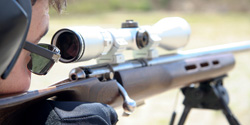 If you have a bolt action rifle make sure to bore sight your rifle before you go to the range after you have mounted the scope.
When mounting a scope make sure to use the proper mount and screws to fit the rifle that is being fired. This will eliminate any potential problems with the scope becoming dislodged when a rifle kicks.
Necessary Equipment
Call ahead if unsure what type of lanes and materials the range you are going to has on its grounds. Some basic items to bring with you can help the process go more quickly.
- Padding for your shoulder to help shield from a rifle kick
- Rifle Rest or Sand Bags to use as a turret for better shot groups
- Enough ammo to zero in the rifle. Try to get ammo from the same lot number which can be found on the side of each box.
- Screwdrivers for adjusting the scope
- 25 to 100 Meter targets
- Black Marker to mark your previous shots
- Binoculars to look down range to see each shot group
Target
Targets are usually set-up for 25 meters for first group and 100 meters to zero in a rifle for maximum point blank range. Each three round shot group should be aimed at the center bulls-eye for the duration of the zero in process. A shot group consists of three well-placed shots, which in turn should be marked to see which direction you need to move the elevation and windage on the scope.
Rifle Position
Rifle position is important to maintain. Once finding a comfortable position to zero in a rifle, make sure it is the same position you fire from every single time.
- Make sure to have the rifle butt firmly placed in then soft tissue area on the shoulder just below your clavicle. Don't place it directly into your clavicle or you could cause damage to your shoulder/bone.
- The opposite arm you are using should be under the forearm of the rifle and the end of the rifle forearm should be on the rifle rest or sandbags.
- A well placed grip behind the trigger area of the rife to ensure it doesn't move during each shot. Do not place your finger on the trigger until you are ready to shoot.
- Use the soft padding just below your distal phalange on your index finger to fire each shot. It should take barely any effort to squeeze each shot on the trigger if done correctly.
- Place your nose or the side of your cheek on the barrel of the rifle. Do not get directly in front of the scope and bolt, or you will get smacked in the face after each shot from the recoil. Once you have found a comfortable spot to place your face for firing position this should be where you place your face EVERY single time for each shot group.
- 30-06 vs. 270 Win
- AK-47 vs AR-15 History and Facts
- Lets make a Sawed-Off Shotgun!
- Make Homemade Mosquito Trap
- Joe Biden Toilet Paper
- Bushcraft 101
- Best Ammo Boxes
- Advertise
Shot Group
 Once you have determined your shot group in relation to the center of the target you can then adjust the elevation and windage on the scope. The scope should have directions on how many clicks per-meters it should be moved.
For example: if you have a shot group in the top-right you would adjust the scope down and left. Continue to do this until you get three (9 Total shots) well-placed shot groups in the center of the target.
100 Meter Target
The final step is to determine the maximum point blank range. Set-up a target at 100 meters and using the same method of shot groups. Long range rifles (.243 w/90 Grain bullet or .270 w/130 grain) should be adjusted to land 2.5 inches above the center of the target and medium range rifles (30-30 w/150 grain or .300 Savage w/165 grain) should land 3 inches above the target. Once the elevation and windage is correct and you have three more (9 total shots) well-placed groups then you have successfully zeroed in your rifle.
Contributing Author: Jason Brumett
Thanks to amagill for use of the photo.
Related Articles
Please like, share, favorite, bookmark, and comment. Thank You.